
Gary Cheung · Published 14 May 2025 · 5 min read
At a glance
- The risk: Unapproved AI can move sensitive data or influence work outside established controls, while an approved tool can still be misused for an unapproved purpose.
- The governance implication: The boundary must apply to the use case, data, integrations, and decision consequence—not simply the product name.
- The leadership takeaway: Make the approved path easier to use, assign an accountable owner, and define who can challenge or stop a workflow when conditions change.
The consequential decision is not whether an organization “allows AI.” It is which AI-enabled workflows may handle which information, influence which business decisions, and operate under whose authority.
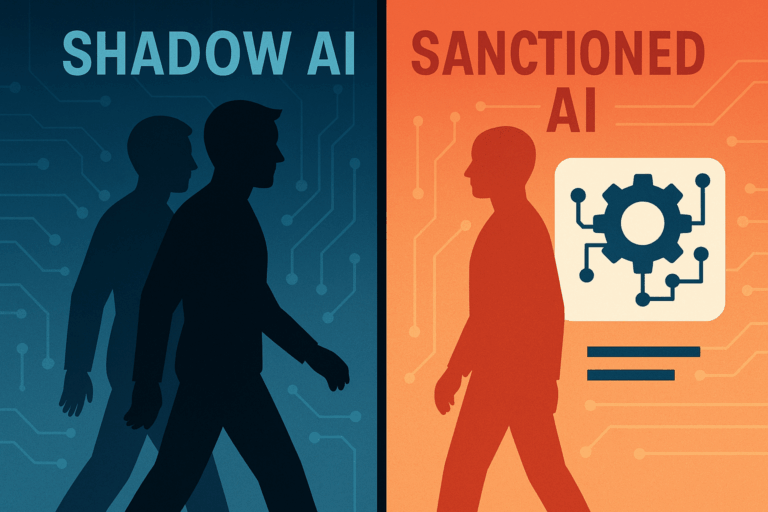
That distinction matters because the line between Shadow AI and sanctioned AI is not the logo on the screen. An unapproved tool may create obvious exposure, but an approved service can also become a governance problem when people use unreviewed connectors, sensitive data, or high-consequence purposes. Approval is a boundary, not a permanent safety label.
The Boundary Is the Use Case, Not the Tool
A sanctioned service should mean that a defined use has been assessed under defined conditions. Those conditions include the data class, account type, configuration, integrations, users, retention, output handling, and the decisions the workflow may support.
If any of those conditions change, the original approval may no longer answer the risk question. Connecting a new repository, enabling an agent to take actions, or moving from drafting text to influencing customer eligibility can materially change the exposure even when the product itself is unchanged.
This is editorial judgment: leaders should treat “approved” as a controlled decision record with scope and expiry—not as a blanket endorsement of every future use.
Shadow AI Is Often a Governance Signal
Employees may turn to unsanctioned tools because the approved path is slow, hard to find, poorly integrated, or unable to solve the work in front of them. That does not excuse bypassing controls, but it means detection alone will not resolve the underlying demand.
An illustrative scenario is a relationship manager using a public assistant to summarize client notes because the approved platform cannot access the required workflow. The risk is not limited to intentional misconduct. It includes an ordinary business task crossing an unassessed data and supplier boundary.
Leaders should therefore ask what the usage reveals: Is there an unmet need? Is the approval process proportionate to the risk? Can employees quickly identify permitted tools, data, and escalation routes? Shadow AI can be a control failure and a design failure at the same time.
Sanctioned AI Still Carries Residual Risk
NIST’s voluntary AI Risk Management Framework 1.0, released on 26 January 2023, calls for documented roles, responsibilities, policies, and mechanisms to inventory AI systems. Its Generative AI Profile, published on 26 July 2024, includes actions such as maintaining approved provider lists, inventorying third parties with access to organizational content, and updating acceptable-use policies.
These practices support governance; they do not establish that an approved workflow is risk-free. A sanctioned system can still produce inaccurate output, expose information through excessive permissions, inherit supplier risk, or be used beyond its assessed purpose.
The UK National Cyber Security Centre’s 27 November 2023 secure-AI guidance similarly emphasizes supply-chain assessment, documentation of data, models and prompts, access control, logging, monitoring, and incident management. The guidance is aimed primarily at system providers, while also encouraging managers, decision-makers, and risk owners to use it.
Design an Approved Path People Can Actually Follow
Start with a short use-case record: business purpose, accountable owner, users, data classes, provider and configuration, connected systems, expected outputs, decision consequence, monitoring, and review date. High-consequence uses should receive more scrutiny than low-risk drafting or ideation.
Provide a practical route for experimentation. A controlled sandbox, clear data-handling rules, and a fast escalation path are often more effective than a policy employees cannot translate into daily work. Monitoring should be proportionate and transparent, with findings used to improve the approved path as well as enforce it.
Finally, define stop authority. Someone must be able to pause the workflow when a provider changes its terms, a connector expands access, monitoring reveals unexpected behavior, or the use case drifts beyond approval. Without that authority, “sanctioned” becomes a historical fact rather than an active control.
Questions Leaders Should Be Able to Answer
- What exactly was approved—the product, or a documented use involving specific data, integrations, and decision consequences?
- What unmet business need is driving employees toward unsanctioned tools, and can the approved path address it proportionately?
- Who owns the residual risk, and who can pause the workflow when its purpose, supplier, data access, or behavior changes?
Closing Thought
The line between Shadow AI and sanctioned AI is not a procurement line. It is a living governance boundary around purpose, information, authority, and consequence. Leaders should know where that boundary sits—and whether anyone can enforce it when the work moves faster than the policy.
Sources and Further Reading
- NIST, Artificial Intelligence Risk Management Framework (AI RMF 1.0), 26 January 2023 — voluntary guidance for managing AI risk.
- NIST, Generative AI Profile (NIST AI 600-1), 26 July 2024 — a voluntary companion resource for generative AI.
- UK NCSC and international partners, Guidelines for Secure AI System Development, 27 November 2023
- AI Is the New Insider Threat (And Most People Don’t Realize It)
- Secure AI Deployment: 5 Critical Vendor Checks for Prompt Data Privacy
About Gary: Gary Cheung writes about AI governance, information risk, and application security. Contact Gary to discuss a consequential AI decision.


