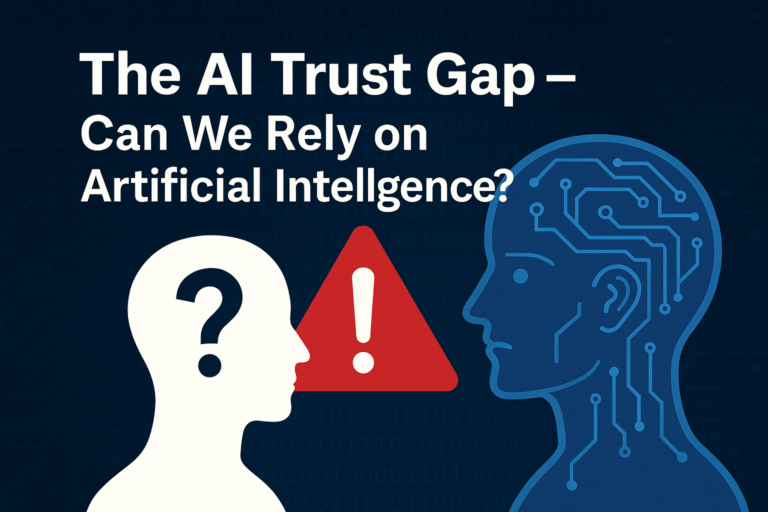
At a glance
- The risk: People may be asked to rely on AI decisions without enough evidence, clear accountability, or a practical way to challenge errors.
- The governance implication: Trust depends on the system’s purpose, evidence, oversight, security, and remedy—not on a promise that AI is transparent or unbiased.
- The leadership takeaway: Make reliance conditional on fit-for-purpose evidence, named decision ownership, and a usable route to review or correct outcomes.
Trust in AI is often treated as a question of whether people feel comfortable with the technology. For leaders, it is also a question of whether the organization has earned reliance: can it explain what the system is used for, show how it performs in that context, and respond when it fails?
Trust should be calibrated to the decision. A low-impact drafting assistant and a system influencing access to healthcare, credit, employment, or public services require different evidence and safeguards. Confidence without controls creates exposure; blanket distrust can obscure where carefully governed tools may help.
Trust breaks when responsibility is unclear
When an AI-supported outcome is wrong, people need to know who can review it, what evidence is available, and how to seek correction. Responsibility cannot be assigned to “the algorithm.” Developers, vendors, deployers, operators, and decision owners contribute different controls, but the organization using the system must identify who owns the final decision and the resulting obligations.
Several examples often cited in discussions of AI trust need careful framing. The Dutch childcare benefits scandal involved discriminatory risk profiling and serious failures in public administration; it should not be reduced to a simple claim that an AI tool falsely flagged thousands of people. Financial services controversies likewise vary by product, evidence, and legal findings. Strong analysis describes the specific system and decision instead of using an allegation as proof of a general claim.
Evidence is more useful than a promise of explainability
“Explainable AI” is not a single control, nor does a technically interpretable model automatically make a decision fair or appropriate. The evidence leaders need depends on the use: validation against relevant outcomes, performance across affected groups where appropriate, data quality, known limitations, security testing, human review, and records that support investigation.
Public confidence can signal the importance of accountability, but it is not a measure of any one system’s safety. A 2025 Pew Research Center study reported that 55% of U.S. adults surveyed were highly concerned about bias in AI decisions. The same report found that 62% had little or no confidence in the U.S. government’s ability to regulate AI effectively. These findings describe views among surveyed U.S. adults; they do not show that a given AI product is biased.
Build reliance around the decision
Start by documenting the purpose, decision context, affected people, and consequences of error. Then identify the evidence needed before use, the limits on acceptable automation, the role of human review, and the route for appeal or correction. The more consequential or difficult to reverse the outcome, the stronger the safeguards should be.
Trustworthy practice also requires security and change control. Protect the data and system from unauthorized access or manipulation; monitor material performance changes; record model, data, and process updates; and reassess when the use or population changes. Assign a person with authority to pause or restrict use when evidence falls below the agreed standard.
Transparency should be practical and audience-specific. Users and affected people may need to know when AI meaningfully shapes a decision, what factors matter, where human review occurs, and how to raise a concern. Internal risk teams need deeper documentation to test, monitor, and challenge the system.
Treat trust as an operating outcome
A governance framework can help organize responsibilities and lifecycle activities. The NIST AI Risk Management Framework is voluntary; it supports risk management but does not certify a system or prove that a particular decision is trustworthy. Leaders should use frameworks to structure evidence and accountability, then evaluate whether the controls work in the organization’s actual context.
Measure whether the governance process is functioning: Are high-impact uses identified? Are owners named? Are evaluations current? Can people obtain meaningful review? Are incidents and complaints investigated and used to improve controls? These indicators tell leaders more than a single trust score or a generic claim of transparency.
Leadership questions
- What evidence justifies relying on this system for this decision, and what material limitations remain?
- Who owns the outcome and can pause or change the process when results are unacceptable?
- Can an affected person understand how to request human review or correction?
Closing thought
Trust is not granted by an AI label or won through a promise of transparency. It is earned when the organization can show why reliance is justified, who is accountable, and what happens when the system gets it wrong.
Further reading
- Pew Research Center: How the U.S. Public and AI Experts View Artificial Intelligence
- NIST AI Risk Management Framework
- NIST AI RMF FAQ
- Beyond1n0: AI Decision Accountability
- Beyond1n0: The AI Audit Gap
About Gary Cheung
Gary writes about information risk, AI governance, and executive accountability. For a discussion about an AI decision or its governance, contact Beyond1n0.


