When AI Moves Faster Than Governance
In many organizations today, the story sounds reassuring on the surface.
An AI governance framework exists.
Policies have been approved.
Oversight structures are defined.
Yet AI adoption is moving faster than the governance rollout that was meant to guide it.
Teams begin deploying AI-enabled capabilities using existing technology and information risk assessment processes. Security testing still occurs. Controls are reviewed. On paper, governance is “there.”
And yet, once AI systems are in production, uncomfortable gaps emerge:
Prompt guardrails were never clearly defined.
Model ownership and lifecycle management are unclear.
AI-specific risks were never explicitly assessed.
Security testing uncovers issues only after exposure already exists.
From the outside, this can look like a failure of execution.
In reality, it is something else entirely.
Governance Was Present — But Not at the Moment That Mattered
The issue in these scenarios is not that governance was absent.
It is that governance arrived after the most consequential decisions had already been made.
Existing information risk assessments were reused, not because anyone believed they were perfect for AI, but because they were available. AI-specific risk management had not yet been operationalized, so implicit assumptions filled the gap:
That AI risks were sufficiently covered by existing processes
That security testing later in the lifecycle would catch issues early enough
That governance could be “caught up” after adoption began
None of these assumptions are irrational. They are common. They are also rarely articulated as decisions.
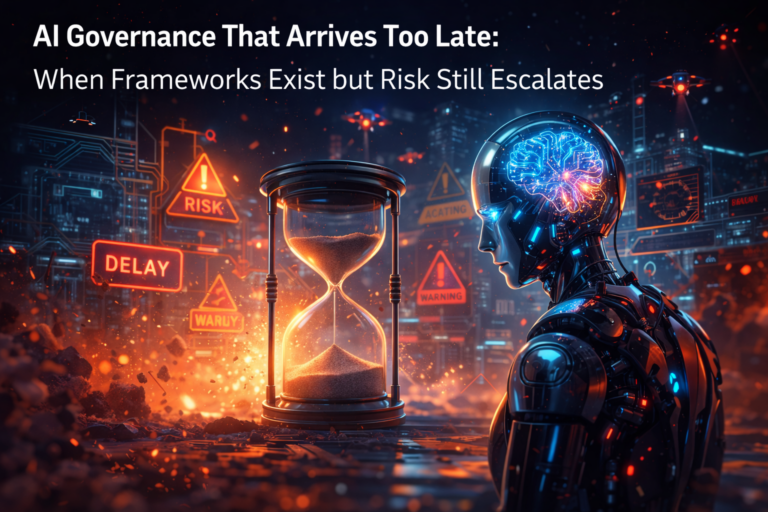
This is where governance quietly fails—not in design, but in timing.
Why Frameworks Alone Don’t Prevent This Outcome
AI governance frameworks are necessary. They describe what good governance should look like.
What they do not do is decide when governance must become mandatory in the delivery lifecycle.
Frameworks don’t answer questions like:
At what point does AI adoption require AI-specific risk assessment?
When does reuse of existing risk processes become insufficient?
Who decides when AI risks can no longer be deferred?
Those are not framework questions.
They are leadership decisions.
When those decisions are left implicit, organizations can comply with governance in form while missing it in effect.
The Consequence: Reactive Control in a High-Velocity Environment
Once AI systems are already live, the organization’s posture changes.
Guardrails are discussed after prompts are already in use.
Model management becomes a clean-up activity.
Risk conversations shift from prevention to justification.
At that point, governance is no longer shaping outcomes—it is reacting to them.
This is often when leadership is surprised. After all, governance was in place. Reviews did happen. Security was involved.
What’s missing is not diligence, but an explicit decision about when AI risk management must intervene before scale and exposure amplify impact.
The Quiet Failure Most Organizations Miss
AI governance failures rarely announce themselves loudly at the start.
They surface later as:
Production incidents
Audit findings
Regulatory questions
Loss of confidence in oversight mechanisms
By then, the real failure has already occurred—not because frameworks were missing, but because governance was unable to influence the decisions that mattered most.
A Final Reflection for Leaders
In AI programs, the most dangerous moment is not when governance is missing.
It is when governance arrives too late to shape adoption decisions—creating the illusion of control until production reality exposes the gap.
That moment is easy to overlook.
And costly to ignore.